
Everything you need to get the best from your Denby Campervan: our owners manual, answers to common questions and helpful guides.
No matches. Try another word, or call us on 01538 382 568.
Things to Know Before Buying a VW Campervan
Volkswagen base vehicle guides
Should I Choose a Volkswagen T6.1 or VW T7 Campervan?
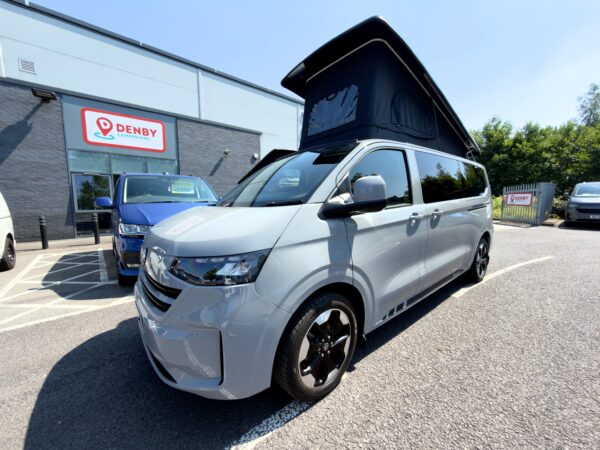
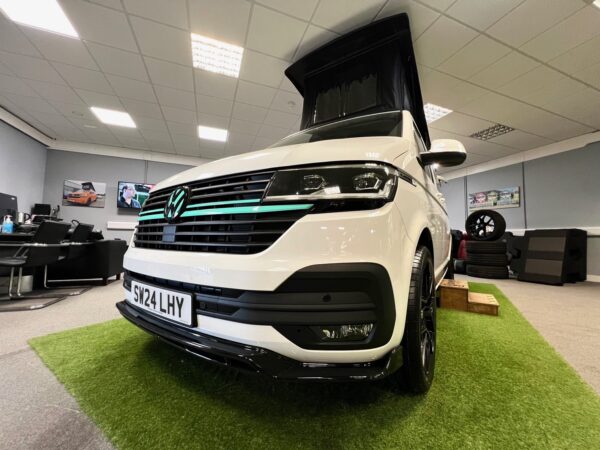
Both the VW T6.1 and newer Volkswagen T7 Transporter are strong choices for a campervan conversion. The T6.1 offers familiar Transporter styling, established conversion layouts and everyday practicality. The T7 introduces newer styling, a modern cab and updated technology; depending on specification, features may include a digital cockpit, reversing camera and driver assistance systems. Volkswagen are also offering their 5+ promise, which covers warranty, roadside assistance, 5 services and 3 MOTs. If you value a well-established model, consider the T6.1. If you prefer a newer-generation vehicle and its updated features, the T7 may suit you better. Our team can help you compare the available conversions and vehicles.
Can I Use a Volkswagen Campervan as My Everyday Vehicle?
Yes. Volkswagen vehicles like to be run often. They do not like to be sat around for too long. Many customers choose a short wheelbase VW Transporter campervan, as it combines a practical day-to-day vehicle with accommodation for trips away. Consider parking space, passenger seating and the layout that best suits your routine.
Should I Choose a Short Wheelbase (SWB) or Long Wheelbase (LWB) Campervan?
A short wheelbase Volkswagen Transporter campervan is a popular option for everyday use because it is easier to park and manoeuvre. A long wheelbase model provides around 40cm of extra vehicle length for both the T6.1 and T7, which can allow more room for storage or alternative layouts. The best option depends on your travel plans, passengers and how much interior space you need.
How Tall Is a Volkswagen Transporter Campervan?
Many Denby VW campervans are approximately 2.1 metres tall with the pop-top roof closed, but the actual height varies with the base vehicle, roof, suspension and wheel specification. Always confirm the measured height of your individual campervan before entering a height-restricted car park or barrier.
How Long Is a VW Transporter Campervan?
As a guide, a Volkswagen T6.1 Transporter is approximately 4.9 metres long in short wheelbase (SWB) form and 5.3 metres in long wheelbase (LWB) form. For the Volkswagen T7 Transporter, these are approximately 5.05 metres long in short wheelbase (SWB) form and 5.45 metres in long wheelbase (LWB) form.
Campervan conversion guides
Which Campervan Bed Is Best: RIB, Rock and Roll or Sliding Rail Bed?
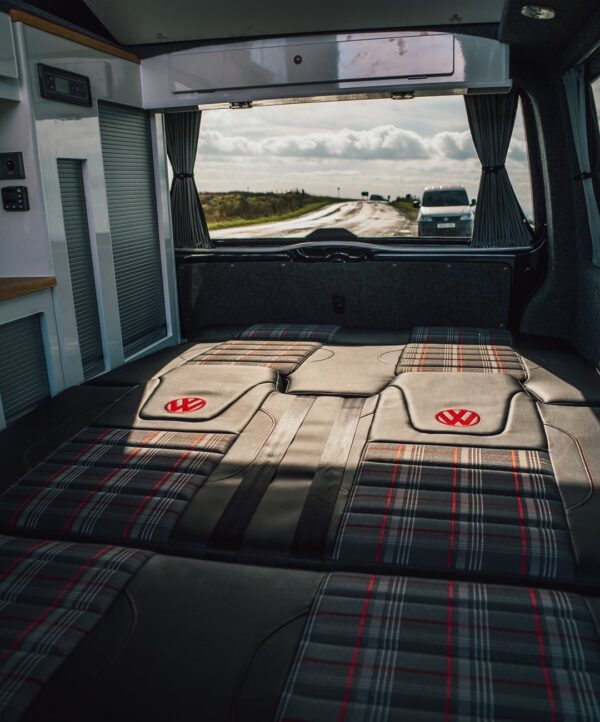
The right campervan bed depends on your priorities. A RIB bed converts from rear seating into a sleeping surface, with a design that uses the reverse side of the seat cushions for sleeping. A traditional rock and roll bed offers a straightforward fold-out seating and sleeping arrangement. A sliding rail bed allows the rear seat/bed to move forwards and backwards, helping you to adjust your living space and rear storage. These options depend on how you plan to use your campervan, your seating requirements and the level of flexibility you need.
Do Denby Campervans Have ISOFIX Child Seat Mountings?
ISOFIX availability depends on the approved rear seat/bed system fitted. Some RIB or Stide configurations may include rear ISOFIX points. Please ask our team to confirm the exact installation and child-seat compatibility before purchasing; do not assume that every campervan has ISOFIX.
What Size Are the Beds in Denby Campervan Conversions?
Bed dimensions vary by bed system, vehicle and conversion layout. A Denby Rock and Roll bed is approximately 6ft 3. Stide bed system is approximately 6ft 3. And a standard RIB bed length is approximately 6ft. See Denby Campervans bed options for further details.
How Many People Can Sleep in a VW Transporter Campervan?
Sleeping capacity depends on the vehicle’s seating within the front cab: does it have 2 single seats, or a bench seat making it a 3-seater cab? It also depends on the conversion layout and seating used, and whether a pop-top roof bed is fitted. Check the number of sleeping berths and approved travelling seats separately, as these are not always the same.
Which Denby Campervan Conversion Should I Choose?
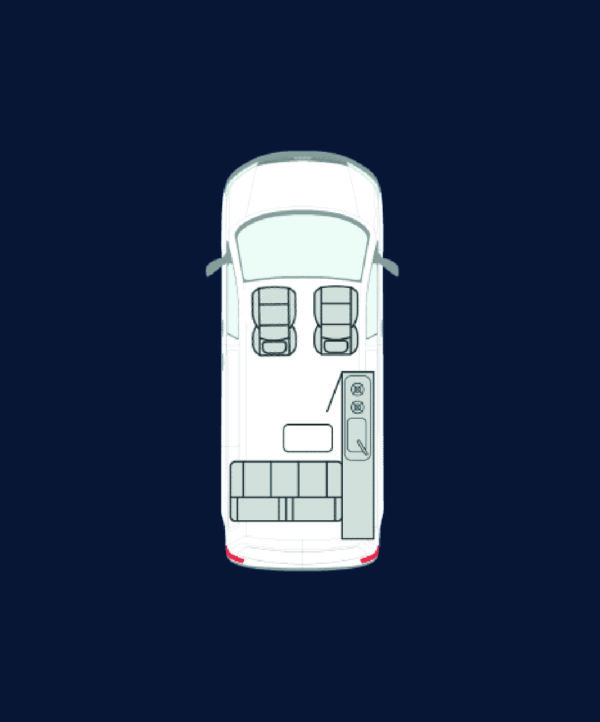
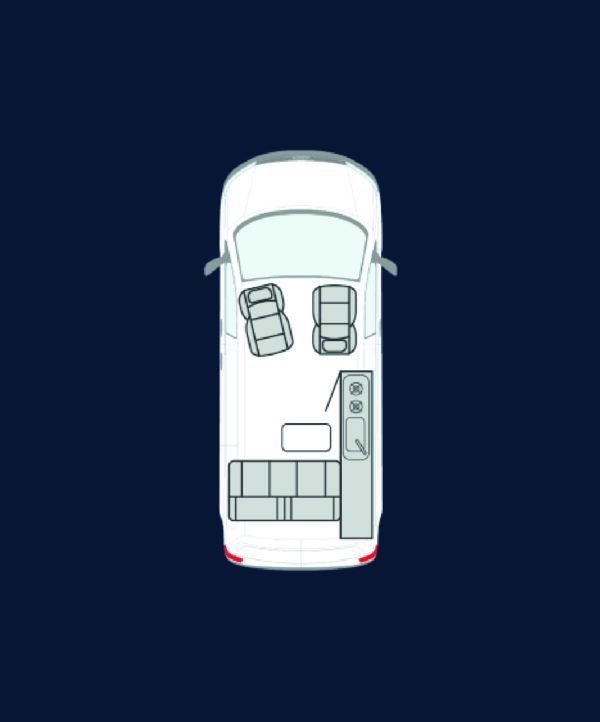
The best conversion depends on how you plan to travel, how many people will use the campervan and which facilities matter most. Our popular Balmoral Deluxe conversion is one option, and we can also discuss other layouts and bespoke requirements. Tell our team about your wish list and we can recommend a suitable design.
Do You Sell VW Campervans with Pop-Top Roofs?
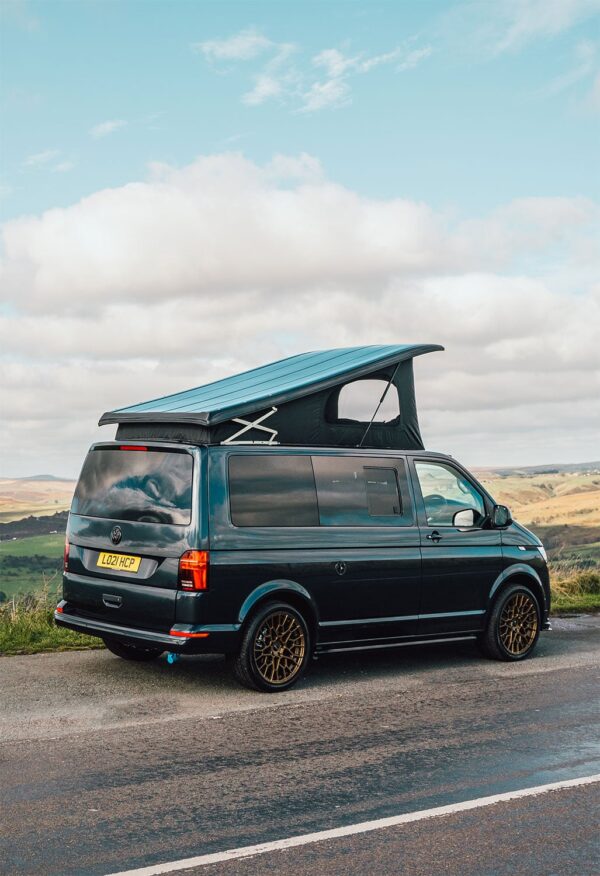
Pop-top roofs are mainly fitted to our Denby Volkswagen Transporter campervan conversions. They provide additional headroom throughout the conversion and can accommodate a roof bed, depending on the specification. Alternatively, we are able to fit a fixed high top roof on bespoke conversions, ask the team for further details.
Should I Choose a Pop-Top Roof or Fixed High-Top Campervan?
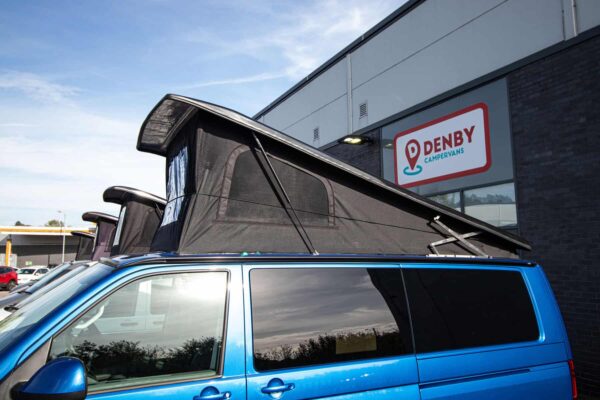
A pop-top roof, also known as an elevating roof, is a popular choice for Volkswagen Transporter campervans, providing additional standing room and the option of an extra sleeping area when raised. When lowered, it keeps the vehicle more compact, making it ideal for everyday driving and use, such as car park barriers and weekend adventures.
A fixed high roof campervan offers permanent standing room, with no need to manually operate a pop-top roof. It provides additional storage potential, making it suitable for extended trips, but will restrict your parking in car parks with height barriers.
Both options have their benefits, and the best choice depends on your camping style, sleeping requirements and how you plan to use your campervan.
What Is the Difference Between a Gas and Gas-Free Campervan?
A gas campervan typically uses a gas cylinder for appliances such as a gas burner hob. A gas-free conversion uses electric cooking equipment instead such as an Induction Hob, supported by the fitted leisure electrical system. The right choice depends on how you travel, your cooking habits and your preference for gas or electric within the conversion.
What Is an Off-Grid Campervan Conversion?
An off-grid campervan conversion is designed to power selected appliances without relying on a campsite electric hook-up. Depending on the build, this may include a lithium leisure battery, inverter, solar charging and induction cooking. How long you can stay off grid depends on your equipment and electricity use.
How Long Will a Leisure Battery Last?
There is no single answer because battery runtime depends on voltage, usable capacity, inverter losses and the appliances you run. High-power cooking equipment / fridges on their highest chill settings use energy much faster than lights or phone charging. Ask us about the electrical specification of the conversion you are considering.
Can I Choose the Colours and Finishes in My Campervan Conversion?
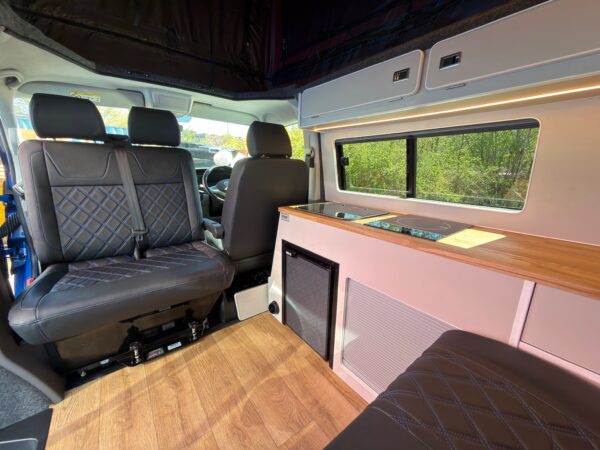
Yes. On vehicles that have not yet been converted, you can choose from a range of furniture colours, flooring, worktops, upholstery and bed options. The choices available depend on the layout and build stage. Check out our conversions page for layouts.
What Flooring Options Are Available for My Campervan?
We offer a range of vinyl flooring options, including suitable Altro and Polyflor products. You can view examples on our conversion pages or visit our showroom to discuss available finishes.
What Campervan Worktop Options Can I Choose?
We offer a selection of worktop finishes, with solid oak being a popular choice. View examples online or visit our showroom to compare the options for your conversion.
Can I Choose Bespoke Campervan Upholstery and Embroidery?
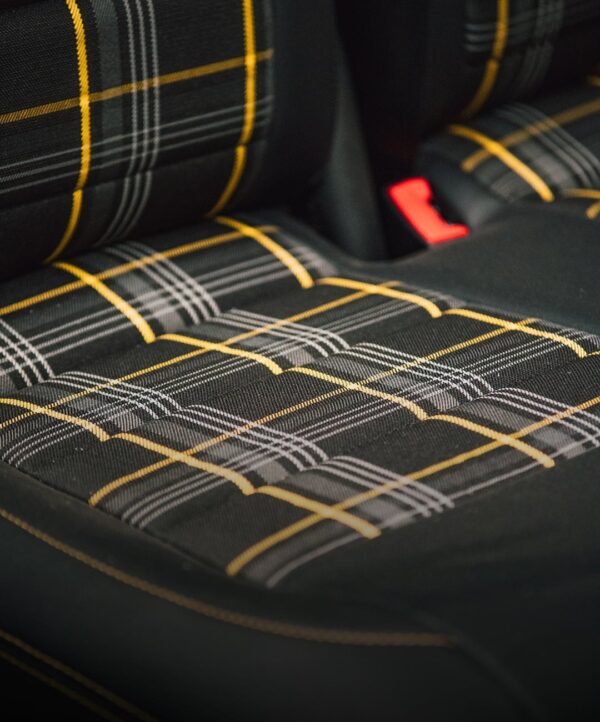
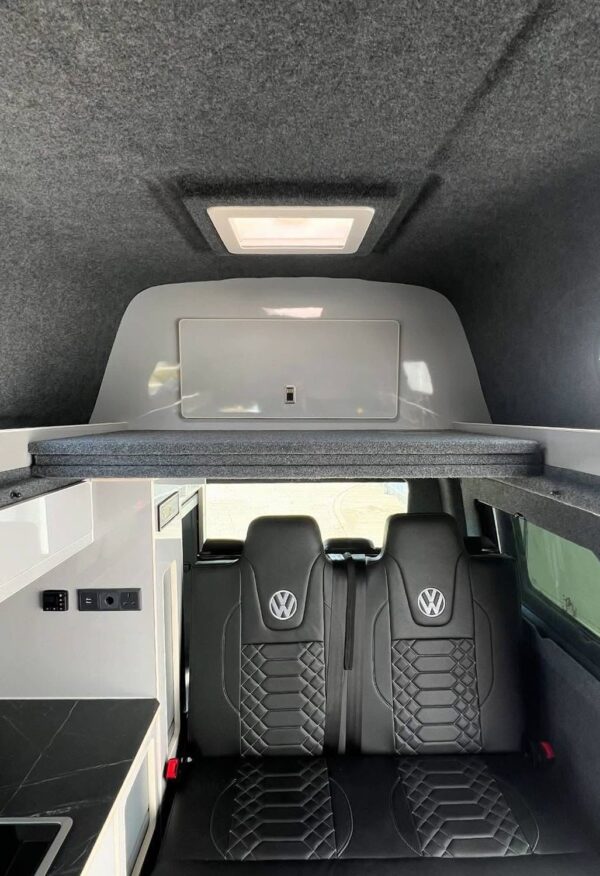
Yes. We offer a range of upholstery and embroidery choices, including leather, cloth and vinyl finishes, colour options and personalised headrest emblems. Ask our team about the options available for your chosen seating and bed system.
Can I Leave Bedding in My Campervan Pop-Top Roof When It Is Closed?
We do not recommend storing loose bedding in a closed pop-top roof. On the roof bed, a mattress no thicker than 35mm, or a self-inflating mattress that is fully deflated, may be left in place. Position it as advised at handover, as far forward to the edge of the roof bed where possible, so it does not interfere with the canvas or rear hinges, and so the elevating pop top roof closes flush.
Do Volkswagen Campervans Have Toilets?
Denby Volkswagen campervan conversions described in this guide include a porta potti as standard. Larger conversions, such as selected Volkswagen Crafter layouts, can be specified with a fitted toilet and shower on request. Check the individual vehicle specification for the facilities included.
Do Volkswagen Campervans Have a Shower?
Volkswagen T6.1 and Volkswagen T7 Transporter campervans can be fitted with a shower attachment at the rear of the conversion on request, ideal for rinsing off muddy boots, sandy feet or muddy dog paws after a day exploring. This is a cold-water system as standard, although a water heater can be added as an optional extra as well, depending on the conversion layout. However, it’s worth considering that installing a water heater will take up some valuable storage space within the conversion. For customers looking for a fully equipped shower room, our larger Volkswagen Crafter campervan conversions can accommodate an enclosed shower with hot water facilities within selected layouts, making them ideal for longer trips and extended touring.
Can I Travel with Pets in My Volkswagen Campervan?
Absolutely! Volkswagen campervans are a great choice for exploring with your four-legged companions. It’s important to ensure your pets are safely secured whilst travelling, whether using a suitable dog harness or a properly secured pet crate. We can fit additional D-ring securing points near the sliding door into the vehicle’s structure, as well as D-ring fittings to the cab seat bases to help secure a dog crate in the rear of your campervan. These optional extras can help keep your pets secure and comfortable whilst travelling, giving you peace of mind on your adventures together. Contact our team to discuss the best options for your campervan conversion.
Campervan buying, finance and ownership
Can I Part Exchange My Car, Van or Motorhome for a Campervan?
Yes. We consider part exchanges involving cars, vans, motorhomes and other suitable vehicles. Contact our sales team with your vehicle details for a valuation.
Can I Buy a Volkswagen Campervan on Finance?
Denby Campervans can discuss hire purchase (HP) finance options through its finance partners. Rates, eligibility and terms depend on your circumstances and the vehicle. Contact our team for current finance information and the required disclosures before applying.
How Long Can I Finance a Campervan For?
Finance terms may be available for up to 120 months (10 years), depending on the vehicle’s age, lender criteria and your circumstances. Contact us to discuss current options and eligibility.
Can I Buy a Volkswagen Campervan Through My Business?
Yes, it is possible to purchase a Volkswagen campervan through your business, whether you’re a limited company or a sole trader. A campervan may be purchased for business purposes, such as travelling for work, attending events or providing accommodation while working away. Depending on how the vehicle is used and your business circumstances, there may be potential tax benefits or VAT considerations. However, the rules surrounding campervans can vary, particularly where the vehicle is also used privately. We always recommend speaking with your accountant or tax adviser before purchasing to understand what allowances or reliefs may apply. At Denby Campervans, our sales team can help you explore the available campervans and purchasing options to suit your business requirements.
Is a Volkswagen Transporter Kombi a Good Choice for Business and Leisure Use?
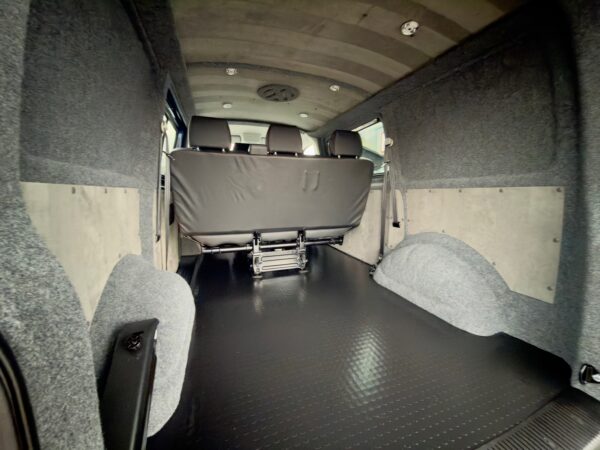
A Volkswagen Transporter Kombi-style vehicle is an excellent option for business owners looking for a versatile vehicle that can be used for both work and leisure. With additional passenger seating and generous rear storage space, a Kombi offers the practicality of a commercial van with the comfort of a passenger vehicle. At Denby Campervans, we can offer bespoke Kombi-style conversions, including upgraded seating, flooring, insulation and additional storage, depending on your requirements. Whether you’re looking for a practical business vehicle or something suitable for weekend adventures, our team can help you explore the available options. If purchasing through your business, we recommend checking any potential VAT and tax implications with your accountant.
Will My Volkswagen Campervan Be Registered as a Motor Caravan with the DVLA?
Following changes to DVLA guidance in October 2026, converted campervans can once again be considered for registration with the body type “Motor Caravan” on their V5C logbook, including vehicles fitted with pop-top elevating roofs or high top roofs.
To qualify, the campervan must meet the DVLA’s requirements for internal living facilities and external features, including suitable windows, sleeping accommodation, cooking facilities and seating. We can process this for you, with all the required photographic evidence and documentation.
Even if a vehicle retains its original body type on the V5C, it can still be used as a campervan, provided it meets the relevant requirements.
Where Can I Get Insurance for My Volkswagen Campervan?
At Denby Campervans, we can recommend specialist campervan insurance providers who are familiar with our vehicles and conversions. We would generally recommend speaking directly with a specialist rather than relying solely on comparison websites, as these can sometimes direct you to insurers who don’t specialise in converted campervans, resulting in lengthy questions or confusion over the vehicle’s specification. Our recommended providers understand our conversions and can help you find suitable cover for your campervan. Please contact our sales team for further details and our recommended insurance providers.
Can I Reserve a Campervan Before the Conversion Is Complete?
Yes! We recommend securing your chosen campervan as early as possible, as our vehicles often sell quickly, particularly once they enter the conversion stage. We offer a 48-hour reservation for just £99, giving you time to make your decision. If you wish to proceed with the purchase, a total deposit of £1,000 is required, including your initial £99 reservation payment. We will then complete an order form with you, discuss any remaining conversion options, confirm the estimated completion date and collection arrangements, and explain when further payments will be required. This allows you to secure your preferred campervan before the conversion is complete.
What Warranty Comes with a Denby Campervan?
All Denby Campervans conversions come with a 2-year conversion warranty, giving you peace of mind when purchasing your new campervan. Depending on the age of the vehicle, there may also be an existing manufacturer’s warranty or additional vehicle warranty available, providing cover for the base vehicle. Should you experience any issues, our team at Denby Campervans is here to help. Simply contact us directly and we can advise on the next steps, including any necessary inspections or repairs.
What Happens When I Collect My New Campervan?
When your campervan is ready, we’ll arrange a convenient collection date and demonstration timeslot. One of our experienced technicians will provide a full campervan handover demonstration, showing you how to operate the bed system, pop-top roof, electrical power system, kitchen appliances and other features within your conversion. We’ll then complete the final paperwork and arrange your vehicle road tax in our main office before handing over the keys to your new campervan.
We recommend allowing approximately 45 minutes for your collection, including the demonstration and final paperwork. You’ll then be ready to head off and enjoy your new adventures!
Buying a Campervan from Denby
Can You Convert My Volkswagen Transporter into a Campervan?
Yes. We offer campervan conversions for Volkswagen Transporter T5, T6, T6.1 and T7 models, as well as selected VW Crafter and Ford Transit vans. Contact us with your vehicle details and preferred layout to discuss what is possible.
Do You Sell Short Wheelbase and Long Wheelbase Campervans?
Yes. Denby Campervans sells and converts both short wheelbase (SWB) and long wheelbase (LWB) Volkswagen Transporters. The right choice depends on how much living space you need and whether you also plan to use your campervan for everyday driving.
Do You Sell Automatic VW Transporter DSG Campervans?
Yes. We offer Volkswagen Transporter campervans with DSG automatic gearboxes when available. Please check our current stock or contact the sales team for suitable vehicles.
Do You Sell Six-Seater Campervans?
Six-seat layouts may be available with a suitable front passenger bench and approved three-seat rear seat/bed system, such as an appropriate RIB or Stide installation. Travelling seat numbers and seatbelt arrangements depend on the specific conversion, so please contact our team to confirm your requirements, 01538 382 568 or via [email protected]
Do You Sell Volkswagen T6 Campervans?
VW T6 campervans may be available through part exchanges. We can also discuss conversion work on a customer-owned VW T6. Contact us for current costing / availability.
Do You Sell Volkswagen T5 Campervans?
VW T5 campervans may be available through part exchanges. We can also discuss converting a customer-owned VW T5. Contact us for current costings / availability.
Do You Have Campervans Ready to Drive Away or Are They Made to Order?
We offer fully converted campervans available to drive away, alongside vehicles in conversion and bespoke orders. If you have a particular Volkswagen model, colour or layout in mind, we can discuss available stock and/or vehicle sourcing options.
Can I Make Changes to a Campervan You Have in Stock?
Depending on the vehicle’s build stage and your requirements, we may be able to adapt a stock campervan. Speak to our team about the changes you would like, and we will advise what is practical.
Do You Sell Used Volkswagen Campervans?
Yes. Our stock includes Volkswagen campervans of different ages, mileages and specifications, subject to availability. If you have a budget or specific requirements, contact our sales team or browse the latest vehicles online.
Do I Need an Appointment to Visit Denby Campervans?
You do not normally need an appointment to visit us. However, letting us know when you plan to come is helpful, so we can make sure someone is available to answer your questions and show you the vehicles you are interested in.
Do You Offer Campervan Delivery Across the UK?
Yes. We can arrange campervan delivery across mainland UK. Where possible, we recommend collecting in person so our team can give you a full handover and demonstrate how the fitted systems and equipment work.
About Denby Campervans & Our Conversions
Where Is Denby Campervans Based?
Denby Campervans is based in Leek, Staffordshire, on the edge of the beautiful Peak District National Park. Our central location makes us easily accessible from Cheshire, Derbyshire, Manchester, the Midlands and further afield.
Customers are welcome to visit our showroom, explore our range of Volkswagen campervans, view our conversion layouts and discuss your requirements with our experienced team.
Our full address is:
Denby Campervans Ltd
Unit 3G, Churnet Park
Sainsburys Industrial Estate
Leek, Staffordshire
ST13 8YH
Who Carries Out Denby Campervan Conversions?
Our campervan conversions are carried out by the Denby team at our facility in Leek, Staffordshire. We build and fit conversions to suit different vehicle models, layouts and customer requirements by our professionally qualified fitters.
Do Denby Campervans Come with a Habitation Certificate?
A habitation certificate can be provided on request. The checks covered depend on the systems fitted and can include gas, electrical and fire-safety items. Please ask the team what documentation is available for your particular conversion.
Which Vans Do Denby Campervans Convert?
We specialise in Volkswagen Transporter campervan conversions, including the Volkswagen T6.1 and newer Volkswagen T7. We also offer conversions for selected Volkswagen Crafter and Ford Transit vehicles. Other models may be considered on request.
Do You Offer Campervan Habitation Checks?
Yes. Denby Campervans offers annual habitation checks, including relevant gas, electrical and water-system checks. Regular inspections help you maintain your campervan and identify issues early. Please check the specific terms of your conversion warranty for any servicing or inspection requirements. Please enquire with our team for costings.
How Many Campervan Conversion Layouts Do You Offer?
We offer approximately six campervan layout designs across different vehicle types, with bespoke options available depending on your requirements. Explore our layouts or speak to the team about how you plan to travel, sleep and use the space.
How Long Does a Volkswagen Campervan Conversion Take?
Conversion times vary depending on the vehicle, layout, specification and workshop availability. For customer-supplied Volkswagen Transporters, our current guide is approximately two to four weeks for the build, subject to availability and the agreed work. Bespoke builds or vehicle sourcing may take longer. We also offer completed campervans that are ready to drive away.
Are Denby Campervan Conversions Insulated?
Yes. Denby campervan conversions use insulation made with recycled materials. Ask our team if you would like details of the insulation used in a particular layout.
What Campervan Furniture Finishes Can I Choose?
We offer a selection of furniture finishes and colour options to personalise your conversion. View the available choices on our conversion pages or contact [email protected] to discuss a bespoke finish.
Can You Fit a Tow Bar to My VW Transporter?
Yes. We can supply and fit suitable fixed or detachable tow bars for selected Volkswagen Transporter models. Contact us with your vehicle details so we can advise on compatibility and pricing.
Can You Fit a Bike Rack to a Volkswagen Transporter Campervan?
Yes. We offer suitable Thule and Fiamma bike rack options, subject to the vehicle and rear-door configuration. Contact our team for compatibility advice and a quotation.
Can You Fit a Diesel Heater to a Volkswagen Transporter Campervan?
Yes. We can offer a few different diesel heater brands. Please enquire with our team for costings.
Campervan Owners Guide
How to operate and get the best from your Denby Campervan, from the pop-top roof to the induction hob.
Roof, seats and interior
Elevating Roof Operation How to close your pop top safely, lock it down and keep the tent waterproof.
When closing your pop top, please ensure the sliding door is always open, as the pressure inside can billow the tent outwards and it can catch on the hinges.
Closing the roof
- Open the sliding door, attach the elastic strap and fold the canvas inwards.
- Pull the roof down approximately 10 inches (25cm) and let it settle.
- Inspect to see that the tent is free, then close the roof completely.
- Tidy up any excess tent by pulling it in towards the campervan, and lock down with the cam buckle straps.
To get the straps tight, hold your thumb on the strap where the black bracket is and pull the straps to avoid spinning.
Reproofing your tent
After many uses (in rain especially) your tent’s water repellent coating may wear. This will cause your tent material to “wet out” (absorb water), instead of the water beading and rolling off. If you experience this you will need to reproof your tent.
We advise using any commercially available waterproofing solution suitable for roof tent material, such as NIKWAX or FABSIL. Best practice is to do this every 12 months.
If you are struggling with your roof, ask us about our bungee options.
Single Swivel Seats How to turn a single swivel seat, including seats with a height adjustment lever.
Some seats have a height adjustment lever. This must be raised before turning. Also lift the arm rests.
To operate the swivel there is a handle or pole either on the front of the seat or to the side. Push this to unlock the plate, then turn.
Double Swivel Seats How to unlock, turn and re-secure a double passenger swivel seat.
Ensure the passenger door is open whilst using.
- Unscrew the 4 locking bolts, lift up and twist to secure them away from the threads.
- Place your hands either side of the base, lower down, and push forward towards the front of the vehicle.
- Then turn anti-clockwise.
- Repeat the operation to return. Put the bolts in loosely so that they align, then tighten.
Try to avoid sand, grit and so on getting into the plates, as this will restrict their operation.
If your double swivel is different to the 4 bolt system, please get in touch with our team who can talk you through.
Bed Operation Opening and closing the bed, the release button and returning it to a seat.
The operation of your campervan bed will depend on the type of bed system fitted within your Denby campervan conversion.
Denby Rock and Roll Bed System
Our standard Rock and Roll bed systems are very straightforward to operate. When opening or closing the bed, always ensure the seat belts are extended fully and kept clear of the mechanism to prevent them from becoming trapped or damaged.
When returning the bed to its seating position, if an electric release button is fitted to the door pillar, press the button to release the mechanism. Your PMS unit must be switched on and your leisure battery must have sufficient charge for the release button to operate.
Using the fitted pull strap, carefully guide the bed back into its upright seating position, using your legs to assist the movement as demonstrated during your handover. Ensure the seat belts feed back evenly and remain clear of the mechanism.
Always check that the bed is securely locked into its seating position before travelling.
RIB Bed System / Stide Sliding Rail Bed System
Both the RIB and Stide bed systems are designed to provide comfortable travelling seats and a separate sleeping surface, using the reverse side of the seat cushions.
To convert the seating into a bed, operate the relevant release handles and carefully rotate the seat base forwards. Lower the backrest section forwards onto its reverse side, followed by lowering the rear section backwards towards the rear doors, creating a flat sleeping surface.
When returning the bed to its seating position, reverse the process, ensuring each section is securely locked into place and the seat belts are correctly positioned and free from obstruction.
If fitted with a Stide Sliding Rail Bed System, always ensure the sliding rail mechanism is securely locked in an approved travelling position before driving.
The position of the release handles and the operating sequence may vary depending on the bed system and model fitted.
Always follow the operating instructions provided during your Denby campervan handover. If you are unsure about operating your bed system, please contact our team for assistance.
Tambour Doors Keeping your space saving tambour doors sliding smoothly.
Tambour doors are a practical, space-saving feature within our Denby campervan conversions. Unlike traditional hinged cupboard doors, they slide neatly within their tracks, allowing easy access to your storage compartments without taking up valuable living space.
To keep your tambour doors operating smoothly, we recommend the following:
- Keep the tracks clean and free from dust, dirt and debris.
- Always open and close the doors gently using the integrated handle groove.
- Avoid overfilling cupboards, as items pressing against the back of the door may restrict its movement or cause the tambour door to come out of its tracks.
- If a door becomes difficult to operate, check the tracks and cupboard contents for any obstructions before attempting to force it.
Useful tip: Occasionally applying a small amount of suitable furniture polish to the tracks can help keep the doors sliding freely. Wipe away any excess to prevent a build-up of residue.
Regular cleaning and a little maintenance will help keep your tambour doors operating smoothly for years to come.
How Do I Open and Close a Denby Campervan Pop-Top / Elevating Roof?
Before operating your pop-top roof, always open the sliding door to allow air to move freely and help prevent the canvas becoming trapped. To open, release the roof safety straps and raise the roof evenly using both hands until the gas struts take over. To close, always keep the sliding door open and pull the roof down steadily using the fitted strap or handles. Guide the canvas inwards, stopping part way, checking that it stays clear of the rear hinge scissor mechanism. If possible, ask another person to check the canvas from outside. Secure both roof straps before driving. Always follow these instructions to avoid any scissor cuts or canvas imperfections. Please also refrain from storing thick bedding or mattress toppers, as this may stop the roof closing.
How Do I Swivel the Single / Double Front Passenger Seat?
The direction and method of rotation depend on the swivel plate fitted to your campervan. The team demonstrates its operation at handover. If you need assistance, contact Denby Campervans on 01538 382568. Make sure the seat is locked securely in its travel position before driving. Driver’s seats will not rotate due to the angle of the units.
What Is the Maximum Weight Limit for a Campervan Pop-Top Roof Bed?
The maximum permitted load depends on the particular pop-top roof and bed system fitted. Our Denby Pop Top / Elevating Roof and Denby Roof Bed are suitable for 2 average adults. Contact our team if you need confirmation for your vehicle.
Power and batteries
Power Management System Where to find the operating instructions for your Power Management System (PMS).
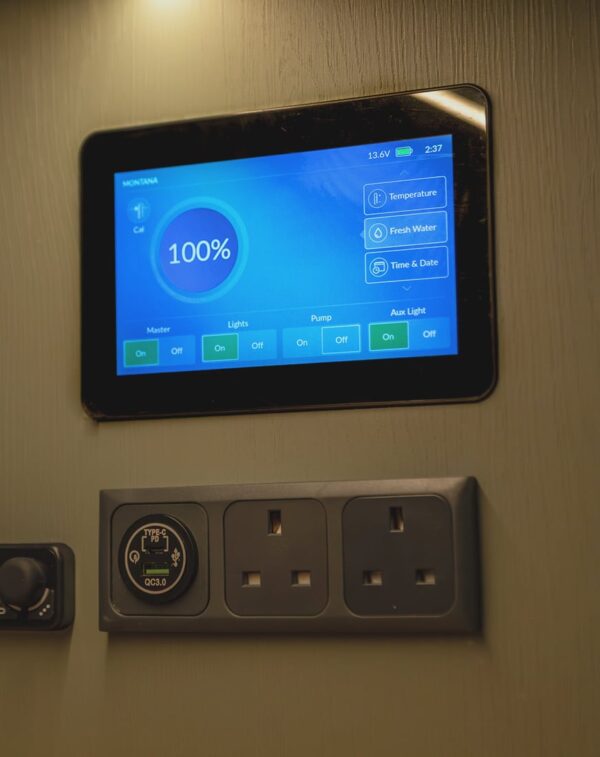
Please see the separate booklet supplied with your campervan for the Power Management System operating instructions.
For help looking after your leisure battery, see Battery Maintenance and the Leisure Battery Charge Chart.
Battery Maintenance How to keep your leisure battery charged and healthy, before and during trips.
We recommend checking the battery voltage, rather than the percentage, as this is more accurate.
Your leisure battery can be charged while driving and from your solar panel. This is only a trickle charge and will take a while to fully charge, especially if you have a vehicle fitted with a smart alternator.
Deep cycle batteries do take a long time to charge, so it is always good practice to charge them with an independent charger prior to camping trips, to ensure you have sufficient power.
Note that some appliances will not run correctly if the battery level drops below 12 volts.
We fit AGM and Lithium leisure batteries as standard, and they must not drop below 11 volts before their first good charge, as this will affect their charging ability thereafter.
Whilst camping it is good practice to run your campervan engine at least once a day for 10 to 15 minutes.
Please see the Leisure Battery Charge Chart for voltage and charge levels.
Leisure Battery Charge Chart Approximate leisure battery voltage against charge state, and the levels to avoid.
| Voltage | Charge state | Note |
|---|---|---|
| Above 12.6V | 100% | |
| 12.5V | 90% | |
| 12.4V | 80% | |
| 12.3V | 70% | |
| 12.2V | 60% | |
| 12.1V | 50% | |
| 11.9V | 40% | Repeated discharge to these levels will shorten battery life |
| 11.8V | 30% | |
| 11.6V | 20% | |
| 11.3V | 10% | Permanent damage can occur |
| 10.5V | 0% |
Please note that these voltages are approximate and are influenced by temperature and other factors. Batteries just taken off charge will have a higher voltage until the surface charge decays, over approximately 30 minutes.
How Can I Monitor Solar Power and Electricity Usage in My Campervan?
Where a compatible solar monitoring system is fitted, you can view the available information through the app provided with your campervan. The readings and functions depend on the equipment installed. Refer to your handover information for the correct app and connection instructions.
How Do I Look After My Campervan Leisure Battery?
Avoid leaving your leisure battery completely discharged. We advise switching off unnecessary equipment when the campervan is not in use. Dependent on leisure battery type, completely discharging the battery can cause cell damage and on occasion will be unable to fully recharge. Before a trip away, we recommend charging for approximately 24 to 48 hours before heavy use. Please refer to the handover booklet for further details.
Where Is the Leisure Battery Located in a Denby Campervan?
With our Denby Campervan conversions the leisure battery is located beneath the driver’s seat. To view, pull the driver’s seat as far forward as possible. The position may differ on other layouts or bespoke builds, please check with the team if you are unsure.
Kitchen, gas and water
Gas Hob Fitting a new gas bottle and lighting the hob for the first time.
When initially using or fitting a new bottle of gas, ensure you screw the regulator on tight.
Then hold down the knob on both burners as you light each one, to expel any air trapped in the system.
Water Tank Why water can come out from under the van when you fill the tank.
Our water tank has a breather hole fitted in the top to expel air.
Don’t be alarmed if you see water coming out from under the vehicle when filling your tank. This generally means you have overfilled the tank and it is releasing the excess water.
How Do I Use the Gas Locker and Gas Bottle in a Denby Campervan?
Denby gas conversions use a Campingaz 907 cylinder housed in a dedicated rear gas locker. A gas regulator is also used. To refit a new bottle, check that the locker ventilation/drop-out opening is unobstructed. Screw the regulator onto the top of the bottle, place it back in the gas locker and ensure you have a secure fit. Isolate the gas supply when not in use and never operate the gas system if you suspect a leak. Contact Denby if you are unsure about safe operation.
How Do I Use the Induction Hob and Inverter?
Our Denby gas-free campervan conversions feature an induction hob powered by the leisure battery system through either a 2000W or 3000W inverter, allowing you to cook without the need for gas.
How to use your induction hob:
- Ensure your leisure battery has sufficient charge before cooking.
- Switch on your inverter using the designated inverter switch as shown within the campervan demonstration. The location depends on the conversion layout.
- Once the inverter is running, switch on your induction hob.
- Place an induction-compatible pan on the hob and select your required heat setting. If fitted with a twin induction hob, we strongly suggest not having both running on the highest heat setting to preserve battery life and condition.
- Once you’ve finished cooking, switch off the induction hob.
- Turn off the inverter when it’s no longer required to avoid unnecessary battery consumption.
Where Can I Find Instructions for My Campervan Kitchen Appliances?
The instruction manuals for the kitchen appliances fitted to your Denby conversion are supplied with the vehicle at collection. Check the manual for each appliance before use, as the controls and operating requirements vary by specification. We also provide a handover booklet on collection, alongside the heater manual and control panel manual within your handover pack.
How Do I Connect the Electric Hook-Up and Fill the Fresh Water Tank?
Within our full Denby Campervan conversions, the electric hook-up socket is located on the driver’s side. Connect a suitable hook-up lead fully and follow the handover / control panel instructions supplied with the vehicle.
With our Deluxe Balmoral conversion, the fresh-water filling point is alongside the hook-up connection. Unlock and remove the cap, fill with suitable fresh water while checking the level indicator via your control panel, then refit and secure the cap correctly. With our Base Balmoral conversion, an onboard water bottle will be located within the tambour door cupboard next to the fridge. Connection locations may vary by conversion.
Wheels and vehicle care
Wheels Wheel nut checks, cleaning your wheels and the tyre pressures we advise.
If you have had new wheels fitted, please check and tighten the wheel nuts after 50 to 100 miles, as they need to bed in and may need tightening.
Wheel maintenance
Please avoid pressure washing and any type of acid or chemical cleaners, as this will void your warranty. (The warranty on aftermarket wheels is 6 months.)
A sponge, soap and water once a week is the best way to maintain and prolong the life of your wheels.
Tyre pressure
We advise a tyre pressure of 40psi all round on 18″ and 20″ fitted wheels.
AdBlue When and how to top up AdBlue without overfilling the tank.
AdBlue needs filling when you get to approximately 1,000 miles remaining.
Please add no more than 10 litres at a time, ensuring the ignition is turned off. Any more than this will overfill the tank and can confuse the vehicle computer system.
If you have overfilled and the engine management light comes on, try driving for a while and this should turn off. Please note that this is a common problem with all the VW models.
Please note that it is your responsibility to ensure proper management and usage of the AdBlue system.
Dash Lights What amber and red warning lights mean, the DPF light and VW emergency numbers.
Please note that from time to time you may get a light coming up on your dash.
- If it is amber or orange, it is an advisory and should be checked by your local VW garage at some point.
- If it is red, this needs looking at by your local VW garage or independent dealer straight away.
DPF filter light
One of the most common lights is the DPF filter. You will have some smoke coming from the back of your vehicle for a short period of time. This is nothing to worry about and can happen at any time. It will generally go off when driving, and is just the excess carbon being burnt off.
VW emergency contact numbers
You will have three years warranty with VW from the date of first registration.
- Roadside Assist: 0800 777 172
- Accident Recovery Service: 08455 395 999
Adaptations and Modifications How adding your own wiring or materials to the conversion can affect your warranty.
Please note: if you make any adaptations to the conversion by adding additional wiring or materials to your campervan, this may void your warranty if any of Denby’s original wiring is deemed to have been tampered with.
Winter storage
Winter Storage of Your Campervan Seven steps to keep your campervan in great condition over winter or any long lay-up.
If you are not using your van over winter, or for extended periods at any time of year, we have compiled some tips and suggestions to help you keep your campervan in great condition.
1. Drain your water tank
It’s vital to drain your water tank in the winter months to prevent the water freezing. This would expand your tank and could cause cracking and damage to the pipework and the tank itself.
2. Charge the battery
Both the leisure battery and the vehicle battery will need charging whilst not in regular use, to prevent any lasting damage. Therefore, if you’re storing your campervan for more than 2 to 3 weeks, we advise you to charge the leisure battery. This will also help to pass a trickle charge through to the vehicle battery, keeping both in good order.
If left for long periods, minor draw on the vehicle and leisure batteries, as well as the ambient conditions, can lead to battery sulphation, which in a lot of cases cannot be reversed. It is good practice to start your vehicle every 10 to 14 days for 10 minutes or so.
3. Turn off your gas taps
Turn off your gas supply at the regulator in your gas box. You can run the remaining gas through your hob, just make sure to leave your door(s) or window(s) open for 10 minutes afterwards to air this out.
4. Clear out cupboards and fridge
Don’t forget to clear out any food and drink, so you’re not coming back to a smelly mess! This will also prevent attracting any insects or rodents.
We also recommend removing any bedding, clothing and soft furnishings to prevent any damp.
5. Wash your campervan
If your van is going to be tucked away for the winter, we recommend giving it a good clean first. Make sure it is fully dry before covering.
6. Cover the van
If possible, cover your van up whilst in storage, as this saves any dirt and debris build up. If this is not possible, ensure all blinds and curtains are shut, and cover the cab area with your screens.
7. Look after your wheels
Change your van’s position every now and again. If you leave your tyres in one position for too long, they could develop flat spots.
Safe journeys,
The Denby Campervans Team
Looking After Your Campervan
What Tyre Pressure Should I Use on My Volkswagen Transporter Campervan?
The correct tyre pressure for your VW Transporter campervan depends on the vehicle, tyre and wheel size. We have a few suggestions below.
- T6.1 16″ Approx 58/61 PSI
- T6.1 17″ Approx 55/57 PSI
- T6.1 20″ Approx 40 PSI
- T7 16/17″ Approx 49 to 54 PSI
- T7 19″ Approx 46-51 PSI
- T7 20″ Approx 36/40 PSI
How Do I Maintain My Volkswagen Campervan Pop-Top Roof?
Denby Campervans Volkswagen pop-top elevating roofs are custom made and use a breathable canvas roof tent. If the canvas becomes wet, open the roof and allow the fabric to dry thoroughly as soon as practical, ideally in a well-ventilated area, to reduce the risk of mould and mildew. Inspect the canvas and seals regularly and use a suitable fabric reproofing treatment in line with the roof manufacturer’s guidance. Check that the canvas is clear of hinges whenever the roof is lowered.
How Should I Store My Campervan Over Winter?
- Drain the water system. Drain the fresh-water tank and pipework in accordance with your handbook instructions to reduce the risk of frost damage. Empty and clean the system before storage.
- Empty the fridge and cupboards. We recommend removing all food and drinks, cleaning the fridge and leaving its door ventilated using the fitted latch where appropriate. This will help avoid attracting rodents to your campervan.
- Secure the gas system, if fitted. Turn off the gas at the cylinder and follow the appliance and gas-system instructions for storage. Store cylinders only in accordance with the relevant safety guidance.
- Remove soft furnishings. Take out bedding, clothing and removable fabrics that could become damp or musty over the winter period.
- Wash and dry the vehicle. We recommend cleaning the bodywork, wheels and roof, removing road grime and debris before storage.
- Choose a suitable parking place. Avoid parking under trees where possible. If using a vehicle cover, choose one suitable for your campervan and remember that covered solar panels will not generate power. Covers will also help avoid any UV fade to the van, the kit and the pop-top roof.
- Maintain both batteries. Both the vehicle battery and leisure battery don’t want to be sat for too long. We advise running your vehicle once a week, and checking over the leisure battery levels every one to two weeks, charging at home if needed.
How Do I Prepare My Campervan for Spring and Summer?
Before heading off on your spring and summer adventures, it’s important to give your Volkswagen campervan a thorough check, particularly if it’s been stored over winter. Start by checking your vehicle and leisure batteries, tyre pressures, fluid levels and ensuring your pop-top roof is clean, dry and operating correctly. Flush and sanitise your freshwater system, and check your fridge, cooking appliances and electric hook-up. Your control panel may have gone into sleep mode if left for too long unused, either pop the fuse out, wait 20 seconds and refit it, or pop out the control panel unit itself if applicable and disconnect it at the back for 30 seconds. We also recommend running your diesel heater to ensure it’s working correctly, as it may still be needed on those chillier evenings. If the heater hasn’t been used over winter, it may take a couple of attempts to start and could produce a small amount of smoke during its initial start-up. If it repeatedly fails to start or continues smoking, have it checked before further use. Finally, check all safety equipment, give your campervan a good clean inside and out, and ensure your servicing and habitation checks are up to date. You’ll then be ready to enjoy the warmer months ahead.
How Much Is My VW Campervan Worth?
The value of a Volkswagen campervan depends on factors including age, mileage, condition, specification and market demand. For a current valuation, email [email protected] or contact us via WhatsApp with your vehicle details and recent photographs, or contact our sales team to discuss a possible part exchange.
How Can I Keep My VW Campervan Cool in Summer?
Park in the shade where possible, use window blinds and create ventilation by opening suitable windows or the pop top side windows to let in air through the mesh panels. Avoid unnecessary cooking inside the van during hot weather. Some diesel heater controllers offer a ventilation-only setting; check your fitted heater manual before using it. Replace any clean stored fresh water regularly, especially in warm conditions, and check that the vehicle air conditioning is operating correctly.